


 Categories
The global shift to clean energy rests on a secure, sustainable supply of critical minerals like lithium and rare earth elements. Yet, traditional extraction methods are often at odds with the very goals of the energy transition, burdened by high energy use, chemical intensity, and significant environmental impact. This is where advanced separation technology offers a transformative solution. High gradient magnetic separation (HGMS) is not merely an auxiliary step but a core enabling technology for cleaner, more efficient critical mineral processing.
The Challenge: The Unsustainable Footprint of Traditional Methods
Conventional processing of lithium and rare earth ores faces a triad of challenges that high gradient magnetic separator technology is uniquely positioned to address:
-
High Impurity Content: Raw ores contain low concentrations of valuable minerals locked within vast amounts of gangue, requiring intensive processing.
-
High Energy & Chemical Intensity: Traditional froth flotation and hydrometallurgical methods are notoriously energy and reagent-intensive.
-
Significant Environmental Impact: These processes generate large volumes of tailings and chemical-laden wastewater, creating long-term environmental liabilities.
 The Solution: Precision, Power, and Purity with High Gradient Magnetic Separation
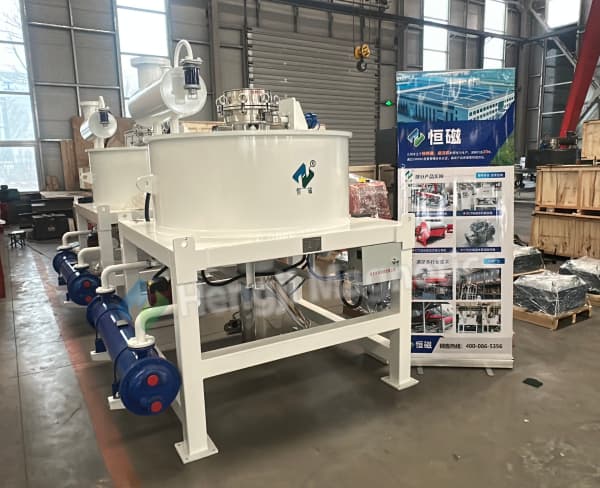
A high gradient magnetic separator generates an exceptionally powerful and sharp magnetic field. This allows it to capture fine, weakly magnetic particles based on minute magnetic susceptibility differences—a capability that unlocks new, sustainable processing pathways.
Empowering Lithium Processing: Pre-Concentration and Purification
For lithium minerals like spodumene and lepidolite, high gradient magnetic separation delivers value at the front end of the process.
-
Pre-Concentration & Waste Rejection: Before ore enters the energy-intensive grinding and flotation circuit, a high gradient magnetic separator can remove a substantial portion (30-50%) of non-magnetic gangue. This “pre-concentration” drastically reduces the mass fed to downstream processes, slashing energy consumption and chemical reagent use from the very start.
-
Iron Removal for Higher Purity: The technology efficiently removes fine iron oxide impurities from lithium concentrates through a purely physical process. This improves the chemical grade of the concentrate for conversion, reducing the need for downstream acid leaching and minimizing waste.
Transforming Rare Earth Processing: Towards a Greener Separation
For rare earth elements, high gradient magnetic separation offers a cleaner alternative to some chemical-intensive steps.
-
Purification of Intermediate Products: After precipitation, rare earth compounds often contain non-magnetic impurities like silica and alumina. A wet-process high gradient magnetic separator can remove these contaminants without chemicals, yielding a purifier feedstock for subsequent separation and reducing the load on solvent extraction circuits.
-
Reducing Chemical Dependency: By introducing a physical separation stage, the overall consumption of strong acids, bases, and organic extractants can be lowered. This directly reduces the volume and toxicity of process wastewater, a major step towards greener rare earth production.
 Why HGMS is the Sustainable Choice for the Energy Transition
The advantages of high gradient magnetic separation align perfectly with the principles of sustainable development:
-
Enhanced Energy Efficiency: As a physical process, it consumes far less energy than thermal or intensive chemical treatments. By reducing the tonnage for downstream processing, it lowers the plant’s overall energy footprint.
-
Reduced Chemical Use: It minimizes reliance on hazardous reagents, leading to safer operations and less environmental remediation.
-
Improved Resource Efficiency: Higher recovery rates and product purity mean more valuable mineral is recovered from each ton of ore, minimizing waste.
-
Process Resilience: HGMS systems are robust, adaptable to various feed conditions, and easily automated, supporting stable, modern production flows.
Conclusion: From Supporting Role to Strategic Enabler
In the quest for sustainable critical minerals, high gradient magnetic separation has evolved from a niche tool to a strategic process enabler. By delivering efficient, chemical-free purification and pre-concentration, it addresses the core environmental and economic pain points of traditional methods. For processors of lithium and rare earths, integrating a high gradient magnetic separator is more than a technical upgrade—it’s an investment in building a cleaner, more resilient, and truly sustainable supply chain for the energy transition.


