


 Categories
In iron ore beneficiation, water scarcity, tightening environmental regulations, and high costs of wet processing are pushing more mining operations to explore dry processing technologies. The dry magnetic drum separator is designed specifically for this need. Using a rotating drum as the core structure, it separates iron ore from gangue minerals based on magnetic susceptibility differences—without water—providing a reliable dry beneficiation solution for mines in water‑deficient and environmentally sensitive regions.
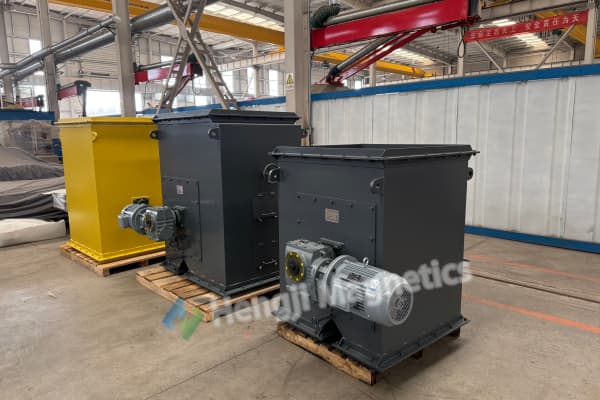
How Does a Dry Magnetic Drum Separator Perform Magnetic Separation of Iron Ore?
The working principle of the dry magnetic drum separator is based on fundamental magnetic separation: material enters the separation zone, and under the combined action of magnetic force and mechanical forces (gravity, centrifugal force), particles with different magnetic properties follow different paths. Inside the drum, a composite magnetic system of high‑strength permanent magnets generates a strong field. Iron ore particles, experiencing magnetic force greater than gravity, are attracted to the drum surface or to the belt covering the drum, carried to the non‑magnetic zone, and then released by gravity and centrifugal force. Non‑magnetic gangue is thrown tangentially by gravity, and the two streams discharge separately—completing the magnetic separation of iron ore process.
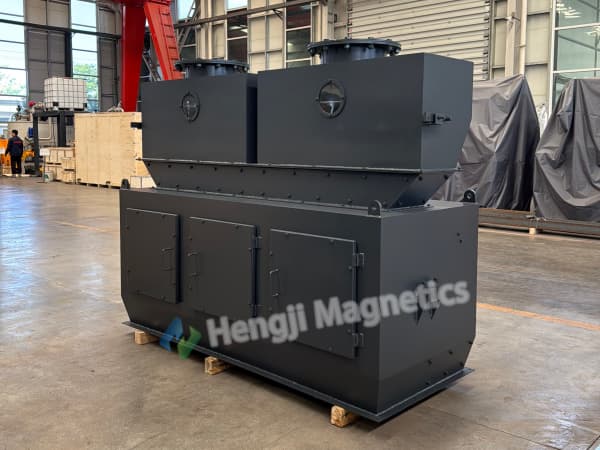 Does the Magnetic Field Strength Meet the Requirements for Different Iron Ore Grades?
In magnetic separation of iron ore, customers often face fluctuations in ore grade and magnetic properties across different deposits and batches. Can the dry magnetic drum separator handle this variation? The drum surface field strength is configurable: standard models reach 150–250 mT, while special models achieve 300–600 mT, covering a wide range of iron ores—from strongly magnetic magnetite to weakly magnetic hematite and limonite. The stainless steel drum shell is available with plain or rubber‑lagged surfaces (plain, chevron, or diamond pattern), providing flexibility to match material characteristics and conveying requirements.
Can the Dry Magnetic Drum Separator Guarantee Recovery Rate and Concentrate Grade?
Recovery rate and concentrate grade are the core metrics in magnetic separation of iron ore. The dry magnetic drum separator uses a computer‑optimized magnetic circuit with high field strength, steep gradient, and deep penetration. High‑grade Neodymium magnets with high energy product and minimal demagnetization—less than 5% over eight years—ensure stable separation performance over the long term. Magnetic iron ore is attracted to the drum surface, carried to the non‑magnetic zone, and discharged into the concentrate collection system. Non‑magnetic gangue is thrown forward by centrifugal force and discharged separately. This precise separation path ensures both concentrate grade and recovery are effectively maintained.
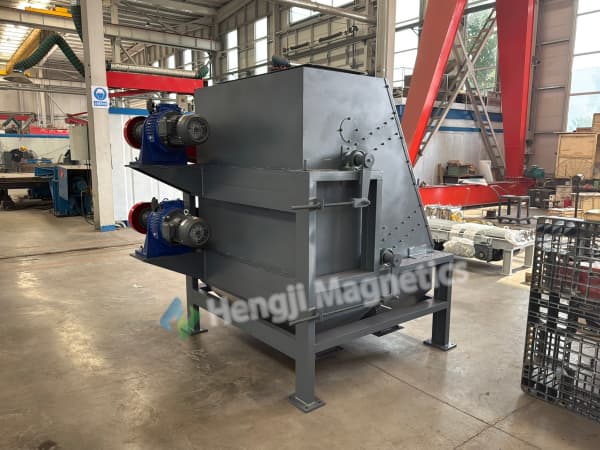 How Does the Dry Magnetic Drum Separator Perform in Terms of Stability and Maintenance?
The magnetic system of the dry magnetic drum separator is fully sealed, with a stable, maintenance‑free field and long service life—the core magnetic circuit carries an eight‑year quality guarantee. The simple, compact structure ensures easy installation, reliable operation, and long‑term trouble‑free performance. The control system can be interlocked with belt conveyors, supporting both local manual and centralized control. Daily maintenance is limited to periodic bearing greasing and gearbox oil changes every six months—keeping operating costs low.
Can the Dry Magnetic Drum Separator Handle Different Iron Ore Particle Sizes?
Mine feed varies widely, from coarse crushed lumps to fine ground powders—each requiring different equipment characteristics. The dry magnetic drum separator, with its configurable field strength and magnetic circuit design, adapts to different particle sizes in magnetic separation of iron ore. Whether coarse or fine, magnetic minerals are effectively captured under the strong field, while non‑magnetic material passes through—achieving good separation performance. Additionally, the dry magnetic drum separator consumes no power to generate the magnetic field, saving energy and reducing operating costs throughout the magnetic separation of iron ore process.
Conclusion
From field strength to separation precision, from operational stability to maintenance convenience, the dry magnetic drum separator offers a dry, efficient, low‑cost solution for magnetic separation of iron ore. It helps mining operations achieve effective separation of iron ore from gangue without water—reducing beneficiation costs while avoiding environmental pressure. For water‑scarce regions and environmentally sensitive applications, the dry magnetic drum separator is a reliable choice for iron ore beneficiation.


