


 Categories
In recycling industries—municipal waste processing, e-waste dismantling, auto shredder residue, glass cullet, and plastic window recycling—non-ferrous metals like copper and aluminum are often mixed with plastics, glass, wood, and other non-metallic materials. These valuable metals are difficult to separate effectively, leading to lost revenue and wasted resources. The eddy current magnetic separator has become the key solution. As one of the most effective magnetic separators for recycling, it uses high-frequency alternating magnetic fields to eject conductive metals, turning waste into valuable resources.
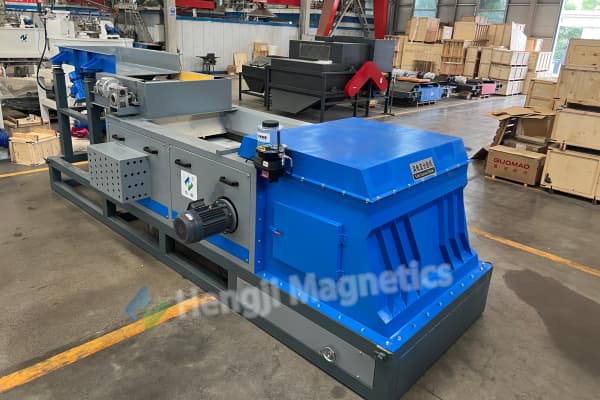
How Eddy Current Magnetic Separator Works in Magnetic Separators for Recycling
The eddy current magnetic separator uses differences in electrical conductivity. Its principle is based on two physical phenomena: a time-varying alternating magnetic field always accompanies an alternating electric field, and a current-carrying conductor generates a magnetic field. During operation, a high-frequency alternating strong magnetic field is generated on the separation rotor surface. When conductive non-ferrous metals pass through this field, eddy currents are induced inside the metal. These eddy currents generate a magnetic field opposite to the original field direction. The non-ferrous metal is then propelled forward along the conveying direction by the repulsive force, separating it from non-metallic materials. The main separation criterion is the ratio of conductivity to density—materials with higher ratios separate more easily. This is why the eddy current magnetic separator is so effective among magnetic separators for recycling.
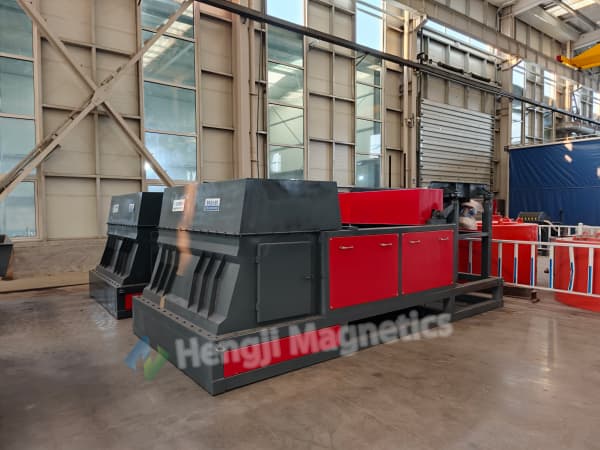 Key Components of Eddy Current Magnetic Separator for Recycling Applications
The eddy current magnetic separator consists of two main parts: the separator body and the control cabinet. The body includes the magnetic separation assembly, drive motor, frame, and housing. The separation assembly is the core component, consisting of a permanent magnetic drum and a material conveying system (conveyor belt, drive drum, and geared motor). The separation rotor assembly is connected to the motor through bearing housings. The geared motor and non-magnetic drum are mounted on the frame assembly. The conveyor belt system forms a rotary system. A splitter plate assembly is mounted on the frame and can be adjusted based on material volume, density, and conductivity for better separation. A protective cover surrounds the frame to prevent material ejection or accidents. A vibratory feeder is installed at the end of the upper frame, supported by damping devices for uniform feeding. These components make the eddy current magnetic separator a reliable choice among magnetic separators for recycling.
Customer Concerns Solved by Eddy Current Magnetic Separator
Recycling operators repeatedly ask: How can aluminum cans and iron metals be separated quickly? How can non-ferrous metals be removed from plastic window recycling? Can aluminum and copper blocks be efficiently sorted from auto shredder residue? How can non-ferrous metals be cleaned from glass cullet? The eddy current magnetic separator answers these concerns. It efficiently separates aluminum, copper, and other non-ferrous metals from mixed waste. The splitter plate can be adjusted to suit different material sizes, densities, and conductivities. The vibratory feeder ensures uniform feeding, improving separation accuracy. As a result, magnetic separators for recycling that incorporate eddy current technology deliver high recovery rates and increased recycling value.
Case Study: Eddy Current Magnetic Separator in E-Waste Recycling
An e-waste recycling company processed refrigerator dismantling lines. The separated material contained aluminum cans, iron metals, and plastics. Traditional equipment struggled to separate copper and aluminum from non-metallic materials, resulting in low recovery value. After introducing the eddy current magnetic separator, material was fed evenly through the vibratory feeder onto the conveyor belt. Under the high-frequency alternating strong magnetic field on the separation rotor surface, conductive aluminum cans and copper blocks were ejected forward by the repulsive force generated by induced eddy currents. They separated smoothly from non-metallic materials. Iron metals were carried out by the non-magnetic drum and conveying system. By adjusting the splitter plate angle, the eddy current magnetic separator achieved precise separation based on material volume, density, and conductivity. After the upgrade, recovery rates for copper and aluminum improved significantly. Recycling value increased substantially. The equipment ran smoothly with uniform feeding. Overall economic benefits improved markedly. This case demonstrates the practical value of magnetic separators for recycling that use eddy current technology.
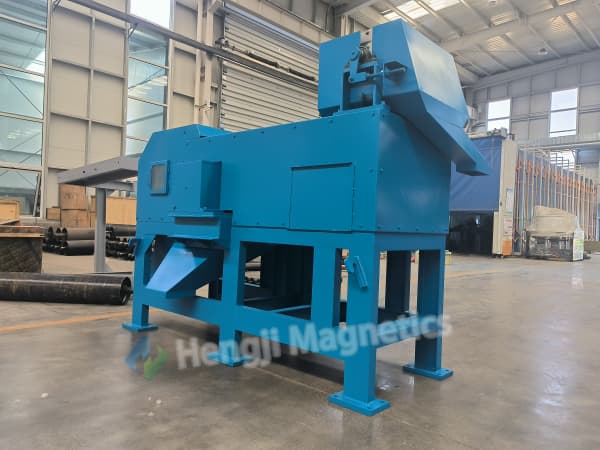 Applications of Magnetic Separators for Recycling
The eddy current magnetic separator is mainly used to recover copper, aluminum, and other non-ferrous metals from municipal solid waste, industrial waste, e-waste processing, glass cullet, waste plastic doors and windows, boiler bottom ash, and auto shredder residue. It is widely used in waste treatment, waste electrical appliance recycling, and non-ferrous metal processing. Specific applications include e-waste processing (refrigerator dismantling lines), separating aluminum cans and iron metals, separating non-ferrous metals from boiler bottom ash, sorting aluminum or copper blocks from auto shredder residue, separating non-ferrous metals from glass cullet, separating non-ferrous metal impurities in plastic recycling lines, separating non-ferrous metals from plastic window recycling, and separating non-ferrous metals from wood. With high-frequency alternating magnetic field separation and stable uniform feeding, the eddy current magnetic separator is solving real non-ferrous metal recovery challenges. It helps recycling companies turn waste copper and aluminum into real money. As a key category of magnetic separators for recycling, it delivers reliable performance.
Why Choose Eddy Current Magnetic Separator as Your Magnetic Separators for Recycling
The eddy current magnetic separator offers several advantages. It provides high separation efficiency for non-ferrous metals. It handles a wide range of material sizes and densities. The adjustable splitter plate allows precise control. The vibratory feeder ensures uniform feeding. The equipment is robust and reliable for continuous operation. It requires low maintenance. It delivers high return on investment by recovering valuable metals from waste. For any recycling operation, the eddy current magnetic separator is a smart investment. It is one of the most effective magnetic separators for recycling available today.
Conclusion
The eddy current magnetic separator is the core equipment for recovering copper, aluminum, and other non-ferrous metals from mixed waste. As a leading example of magnetic separators for recycling, it turns waste into value. If your recycling line is losing non-ferrous metals, contact us today for a free application review. Let the eddy current magnetic separator help you recover more and waste less.


