


 Categories
Capturing micron-sized, weakly magnetic particles has long been one of the most difficult challenges in mineral processing. Traditional equipment struggles because these particles are tiny—their mass is minuscule—and the magnetic force required to separate them must compete with gravity, fluid drag, and surface adhesion on equal terms. The breakthrough came with the development of the strong magnetic roll. By optimizing both field strength and field gradient, this advanced magnetic roller technology now makes it possible to capture particles that were once considered unrecoverable.
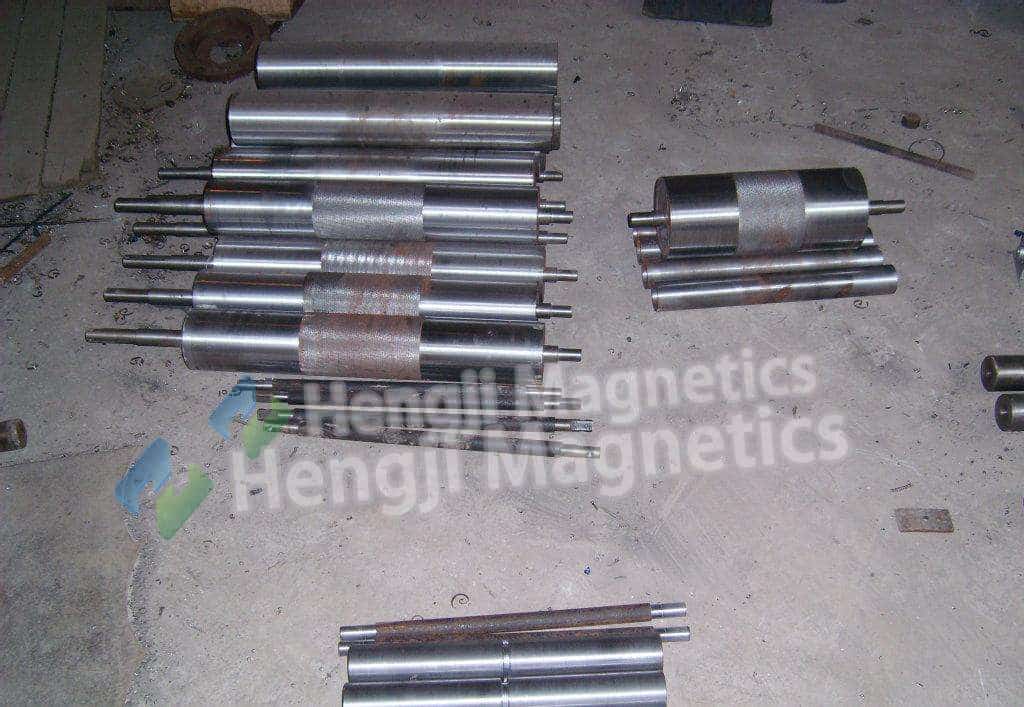 Why Traditional Magnetic Rollers Struggle with Fine Particles
A conventional magnetic roller relies primarily on magnetic field strength to attract ferrous particles. For coarse, strongly magnetic materials, this works well. But for micron-sized weakly magnetic impurities—like fine hematite, ilmenite, or iron oxides in industrial minerals—the physics is different.
The magnetic force on a particle is proportional to its volume. When particle diameter drops below 10 microns, the volume shrinks by a factor of 1,000 compared to a 100-micron particle. The magnetic force becomes vanishingly small, often weaker than the competing forces of fluid drag or particle adhesion. A standard magnetic roller simply cannot generate enough attraction to pull these fine particles out of the flow.
 The High-Gradient Secret of a Strong Magnetic Roll
The strong magnetic roll solves this problem by exploiting a different physical principle: magnetic gradient. The force on a magnetic particle is actually proportional to the product of the magnetic field strength and the field gradient. For a tiny particle, a massive gradient can compensate for the small volume.
Ultra-High Gradient Zones
The strong magnetic roll is designed with extremely narrow pole gaps, specialized magnetic media (like fine pole teeth or steel wool matrices), or multi-layer magnetic circuits. These features create regions where the magnetic field changes dramatically over microscopic distances—high-gradient zones.
When a micron-sized weakly magnetic particle enters one of these zones, it experiences a force far greater than the background field alone would suggest. The strong magnetic roll acts like a magnetic magnifying glass, concentrating the available magnetic energy onto the tiny particle.
Powerful Background Field
High gradient alone is not enough. The gradient must be built on a foundation of strong, uniform background field. High-grade rare earth magnets—typically Neodymium—provide this foundation. The magnetic roller surface delivers consistent, intense field strength across the working zone, ensuring that the high-gradient regions are fully energized.
Mechanical Design: Making the Magnetic Roller Work for Fines
Even the perfect magnetic circuit will fail if the mechanical design does not support fine particle capture.
Specialized Roll Surface
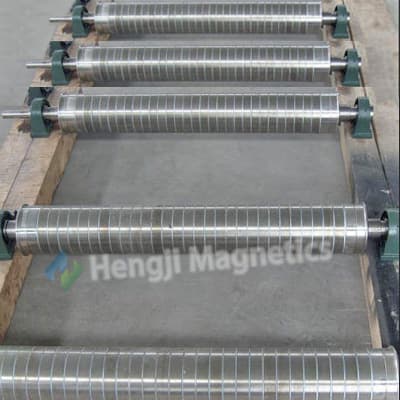
The strong magnetic roll often features micro-grooves, textured coatings, or other surface treatments. These create localized turbulence that helps disperse fine particles and prevents them from adhering to non-magnetic surfaces. The result is that each particle is presented individually to the high-gradient capture zones.
Thin Layer, Slow Speed Operation
Fine particles require time to be captured. A magnetic roller optimized for micron-sized materials operates with extremely thin feed layers—often a monolayer of particles—and slower rotational speeds. This ensures that every particle has sufficient residence time in the high-gradient region to be captured.
Precision Magnetic Circuit Design
Computer simulation plays a critical role. Magnetic field modeling allows engineers to map the gradient distribution across the strong magnetic roll surface, ensuring that the highest gradient zones align precisely with the material contact area. Precision machining maintains the tight tolerances required to keep the gradient stable during operation.
 Real-World Results: What the Strong Magnetic Roll Achieves
A properly designed magnetic roller with high-gradient capability achieves what conventional separators cannot:
-
Effective Capture Below 10 Microns: Particles as fine as 1-5 microns are reliably separated.
-
Weakly Magnetic Mineral Recovery: Iron oxides, ilmenite, manganese, and other weakly magnetic materials are recovered or removed to levels that meet strict specifications.
-
High Purity Industrial Minerals: Quartz, feldspar, and ceramic raw materials achieve brightness and iron content levels required for premium markets.
Conclusion: A New Era for Fine Particle Separation
The strong magnetic roll represents a fundamental advance in magnetic separation. It does not simply rely on brute magnetic force. Instead, it creates localized zones of extreme magnetic gradient that act as precision capture points for particles too fine and too weakly magnetic for conventional equipment.
By combining high-strength rare earth magnets, optimized high-gradient circuits, and precision mechanical design, the magnetic roller has opened the door to processing materials that were once considered impossible to separate physically. For processors of industrial minerals, strategic metals, and fine chemicals, this technology transforms what was once a bottleneck into a competitive advantage. The era of micron-scale magnetic separation has arrived.


