


 Categories
In power generation, mining, metallurgy, building materials, coal preparation, and chemical industries, bulk materials often contain ferrous contaminants—iron blocks, bolts, anchor rods, wire, and steel sheets. If not removed, these can tear conveyor belts, damage crushers and mills, cause production interruptions, and even lead to safety incidents. The suspended belt magnet is designed to solve these problems. Suspended above or at the head of belt conveyors, it uses a powerful electromagnetic or permanent magnetic system to instantly lift ferrous contaminants from moving material streams, and automatically ejects them via a self-cleaning belt mechanism—achieving continuous, non-stop iron removal. This suspended belt magnet combines strong magnetic capture with automated discharge, serving as the first line of defense for safe, efficient production lines. It is widely used wherever magnetic separation of mixtures is required to remove tramp iron from bulk materials.
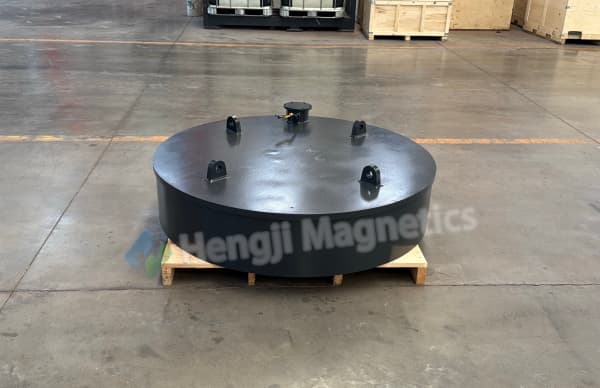
How the Suspended Belt Magnet Achieves Effective Magnetic Separation of Mixtures
The design of this suspended belt magnet focuses on the core concerns of customers in mixture iron removal, delivering separation efficiency and equipment reliability through advanced technology.
Deep Capture from Thick Material Layers
The key concern is whether the equipment can accurately and efficiently lift tramp iron of various shapes and weights from thick, high-speed material streams. Ferrous contaminants are often buried deep in the material burden, demanding high penetration depth and lifting force. The suspended belt magnet uses a computer-optimized magnetic circuit—whether permanent (Neodymium) or electromagnetic—providing high field strength and deep penetration. At belt speeds above 2 m/s, the unit can be positioned slightly away from the head pulley to use material trajectory for improved capture; below 2 m/s, it moves closer to the pulley (which should be non-magnetic) to ensure sufficient retention time. This flexible positioning allows the suspended belt magnet to adapt to varying belt speeds and burden depths, achieving efficient magnetic separation of mixtures.
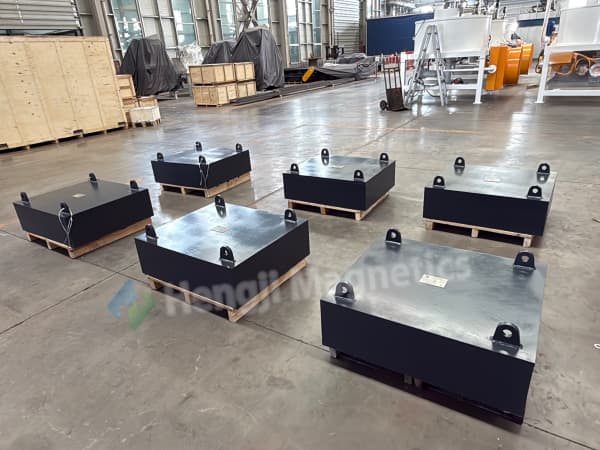 Automatic Discharge and Continuous Operation
What distinguishes the suspended belt magnet from ordinary suspended separators is its self-cleaning belt mechanism. This consists of a geared motor, drive and tail pulleys, idlers, and a discharge belt with scrapers. After the magnet captures tramp iron, the continuously running belt carries the iron beyond the magnetic field, where it loses magnetism and falls into a collection bin—achieving fully automatic, continuous iron removal without manual intervention. Belt tension and tracking adjustments are made without stopping the line, ensuring long-term stability and high automation.
Durability and Harsh Environment Adaptability
The suspended belt magnet is built for heavy-duty, continuous operation in harsh conditions. Electromagnetic models use resin-potted coils with high insulation and temperature ratings, and wave-fin heat sinks for natural convection cooling—maintaining controllable temperature rise during long operation. Permanent models use high-coercivity, high-remanence magnets with a 10+ year maintenance-free service life and very low operating costs. The rugged housing resists dust, moisture, and corrosion, performing reliably indoors or outdoors with minimal downtime.
Installation Flexibility and Space Adaptability
The suspended belt magnet offers multiple installation options—inclined (QX) or horizontal (SP)—and various suspension methods: rod-mounting to fixed hooks, chain suspension from trolleys, or wire-rope suspension from traveling carriages. Customers can choose the best solution for their site layout, easily integrating into existing conveyor systems without complex civil work.
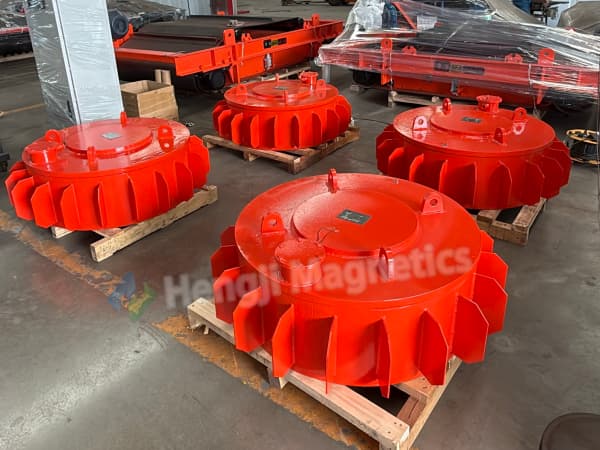 Material Adaptability and Separation Control
The spacing between the magnetic centerline and the head pulley centerline is selected based on pulley radius, belt speed, material properties, and other factors—generally recommended as equal to the pulley radius. For electromagnetic models, excitation current can be adjusted to fine-tune field strength for different iron content levels, achieving optimal balance between separation efficiency and throughput.
Applications of the Suspended Belt Magnet
The suspended belt magnet is widely used in:
-
Mining and aggregates: Removing tramp iron from ore before crushing.
-
Coal handling: Extracting bolts, wire, and steel from coal streams.
-
Cement and building materials: Protecting crushers and mills from metal contamination.
-
Recycling and waste processing: Separating ferrous metals from mixed waste streams.
-
Power generation: Removing tramp iron from fuel feed lines.
Conclusion
The suspended belt magnet is an essential tool for magnetic separation of mixtures in bulk material handling. With strong magnetic capture, self-cleaning discharge, rugged durability, flexible installation, and adjustable operation, it protects conveyors and downstream equipment while ensuring product purity. For any operation seeking to eliminate tramp iron hazards and improve production continuity, a reliable suspended belt magnet is the strategic choice—ensuring every ton of material moves forward cleanly and safely, maximizing resource utilization.


