


 Categories
In the R&D centers of mining companies and mineral processing laboratories of universities, the laboratory magnetic separator plays a critical bridging role between theoretical research and industrial application. Its design serves one clear goal: to accurately simulate and verify the separation process that a material would undergo on a production line, using only a small sample quantity.
When researchers need to assess the final purification potential of a magnetite rough concentrate from a new mining area under high intensity magnetic separation, or evaluate whether a batch of kaolin can reach ceramic‑grade whiteness through high‑intensity separation, the laboratory magnetic separator becomes the only reliable validation tool.
It typically consists of a compact permanent or electromagnetic separation unit whose field strength and gradient are fully comparable to industrial equipment. Together with a precise feeding device and adjustable operating parameters, it allows users to observe, under fully controlled conditions, the true behavior of each mineral particle under high intensity magnetic separation—which particles are captured, which are rejected, and what the capture and rejection rates are. These data directly form the core basis for subsequent industrial equipment selection and process flow design.
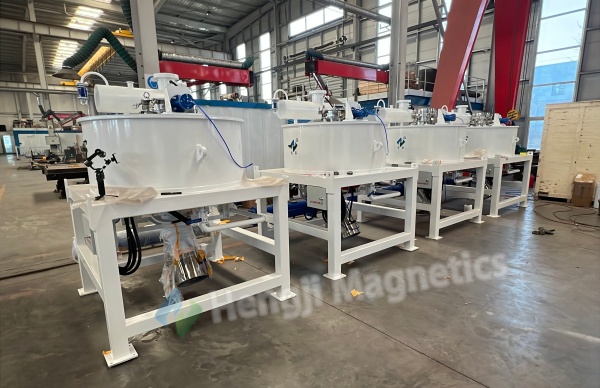
How Does a Laboratory Magnetic Separator Ensure Reliable Scale‑Up and Parameter Flexibility?
For users of a laboratory magnetic separator, two questions matter most: first, can the separation data obtained at lab scale be reliably scaled up to an industrial line; second, does the equipment offer enough parameter adjustment flexibility to simulate different production conditions? These are precisely the two key tasks that the laboratory magnetic separator addresses in its design.
In terms of magnetic circuit design, a high‑performance laboratory magnetic separator can achieve a wide range of field strengths in the separation zone—from low intensity to the levels required for high intensity magnetic separation—by adjusting the excitation current or by exchanging permanent magnetic rolls of different strengths. Operators can freely adjust the field intensity based on the magnetic susceptibility of the material. For strongly magnetic magnetite or for weakly magnetic hematite and limonite, they can explore at what magnetic force level the target minerals begin to be efficiently captured, and at what field strength the ideal separation is achieved.
On the mechanical side, the laboratory magnetic separator typically allows users to adjust drum or matrix speed, feed rate, and separation gap angle. This means customers can simulate in the laboratory the varying operating parameters that might be encountered on an industrial line. They can identify the optimal process combination that satisfies both grade requirements and throughput, providing solid data for scale‑up.
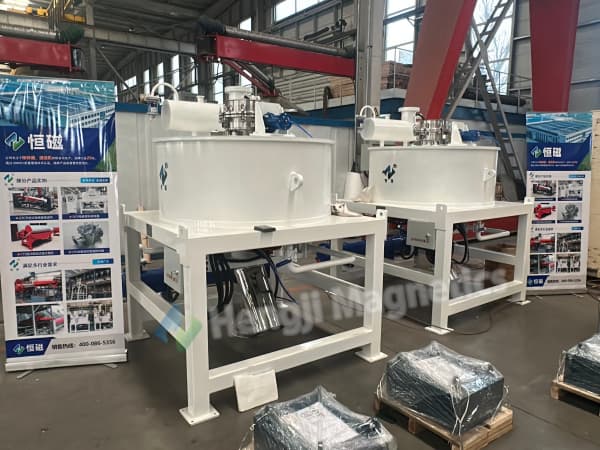 What About Ease of Operation and Data Reproducibility in High Intensity Magnetic Separation Tests?
While providing high intensity magnetic separation capability, the laboratory magnetic separator must also deliver ease of operation and data reproducibility. Any laboratory research depends on repeatable test results. High‑quality laboratory magnetic separator units are therefore built with a rigid frame and precise speed and field adjustment mechanisms, ensuring that every test condition can be accurately recorded and replicated.
The separation zone is covered by a transparent protective shield that allows researchers to monitor material trajectories and the magnetic capture process in real time, giving an intuitive assessment of separation performance. After a test, the magnetic particles captured on the matrix or drum surface can be quickly cleaned using a handwheel or quick‑release structure, allowing the laboratory magnetic separator to be ready for the next test cycle with minimal downtime. This greatly improves workflow efficiency in the laboratory.
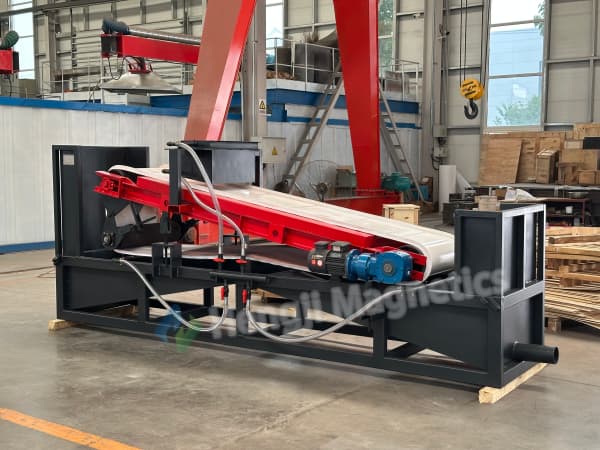 Key Parameters to Control When Using a Laboratory Magnetic Separator for High Intensity Magnetic Separation
To generate reliable scale‑up data, the following parameters should be carefully controlled during high intensity magnetic separation tests on a laboratory magnetic separator:
-
Feed particle size: Ensure the sample is representative of the industrial feed. Screen to a narrow size fraction if needed.
-
Field strength: Test at multiple levels (e.g., 0.5 T, 0.8 T, 1.2 T) to find the threshold for effective capture of weakly magnetic particles.
-
Matrix or drum speed: Vary the rotational speed to simulate different retention times in the separation zone.
-
Feed rate: Adjust the vibratory feeder to achieve a thin, uniform layer, avoiding over‑loading that would bury magnetic particles.
-
Gap angle (for dry drum units): Change the magnetic wrap angle to see how it affects the trade‑off between grade and recovery.
By systematically varying these parameters, the laboratory magnetic separator generates a performance map that directly guides the design of an industrial high intensity magnetic separation circuit.
Which Applications Benefit Most from Laboratory Magnetic Separator Testing?
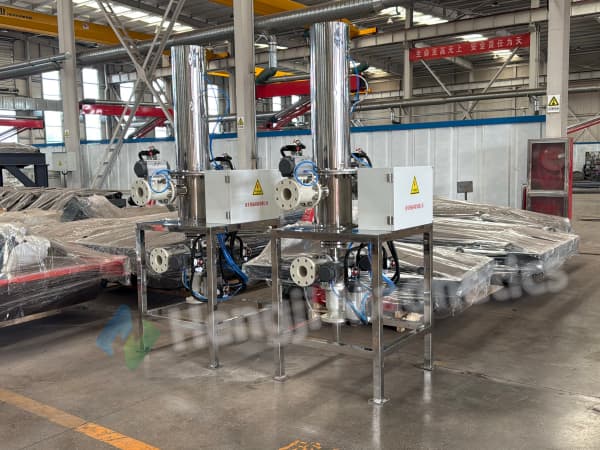 The laboratory magnetic separator is indispensable wherever high intensity magnetic separation is considered for a new or existing process:
-
New ore body evaluation: Determining if a weakly magnetic iron ore (hematite, limonite) can be upgraded to saleable concentrate using dry or wet high‑intensity separation.
-
Non‑metallic mineral purification: Testing the iron removal efficiency from kaolin, quartz, feldspar, or talc to meet ceramic, glass, or filler specifications.
-
Battery material feedstock: Assessing the ability to reduce magnetic foreign matter in lithium carbonate, graphite, or precursor powders to sub‑ppm levels.
-
Tailings reprocessing: Evaluating whether magnetic values in tailings can be recovered economically using high intensity magnetic separation.
-
Process troubleshooting: Diagnosing why an industrial separator is underperforming by replicating the feed conditions on a laboratory magnetic separator and comparing results.
In every case, the laboratory magnetic separator provides the data that answers the critical question: “Will this material respond to high intensity magnetic separation, and at what cost?”
Conclusion: The Reliable Bridge from Lab to Plant
The laboratory magnetic separator is not merely a scaled‑down version of industrial equipment. It is a precision instrument designed to answer the most important question in mineral processing: can high intensity magnetic separation deliver the required purity and recovery at industrial scale?
By offering adjustable field strength, variable speed, flexible gap settings, and easy cleaning, a well‑designed laboratory magnetic separator generates reproducible, reliable data that engineers trust for scale‑up. Investing in a quality laboratory magnetic separator means equipping your research or quality control lab with the tool that de‑risks your industrial magnetic separation projects.
For mining companies, engineering firms, and university labs, the path to successful high intensity magnetic separation starts with the right laboratory magnetic separator. Choose one that combines robust construction, wide parameter adjustability, and user‑friendly operation. Let the data guide your next industrial investment.


